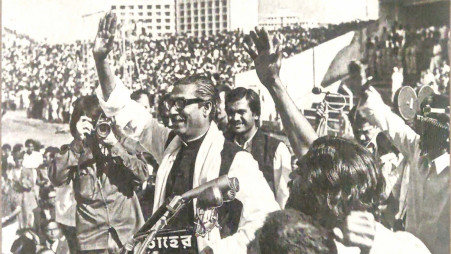
There's a version of Bangabandhu that gets flattened into portraits and street names, and there's the actual thinker behind the four founding principles: nationalism, democracy, secularism, and socialism. I think it's worth sitting with what those actually meant in 1972, because they weren't abstract slogans, they were a response to a very specific set of problems a newly independent country was facing.
Secularism, for example, wasn't chosen lightly in a Muslim-majority country carved out of a partition defined by religion. It was a deliberate stance that the new state would not repeat the communal politics that had, in the eyes of the founders, caused so much damage. That principle has been tested repeatedly over the decades, and I think it remains one of the more underappreciated parts of the country's founding document.
Socialism in the original sense meant something closer to economic justice and reducing inequality rather than a rigid state-controlled economy, and it's fair to say later governments, including Awami League itself, moved toward a more mixed and market-oriented approach. I don't think that's a betrayal of the founding vision so much as an adaptation to reality, the same way most post-independence states eventually adjusted their early economic models.
Whatever your view on how well any government has lived up to these four pillars, I think returning to them regularly is useful. They're a yardstick, not a museum piece, and I'd rather see them argued about than forgotten.
Post
Bangabandhu's Founding Ideals and Why They Still Matter
Log in or create an account to leave a comment.
No comments yet. Be the first to say something!