I've written a lot on this blog about specific development achievements from Awami League's time in government, and I've tried to be honest about the record's limits too. But when I look at the raw macroeconomic numbers from the past two years, I don't think there's much room left for spin, growth has slowed sharply, and ordinary households are the ones absorbing that cost.
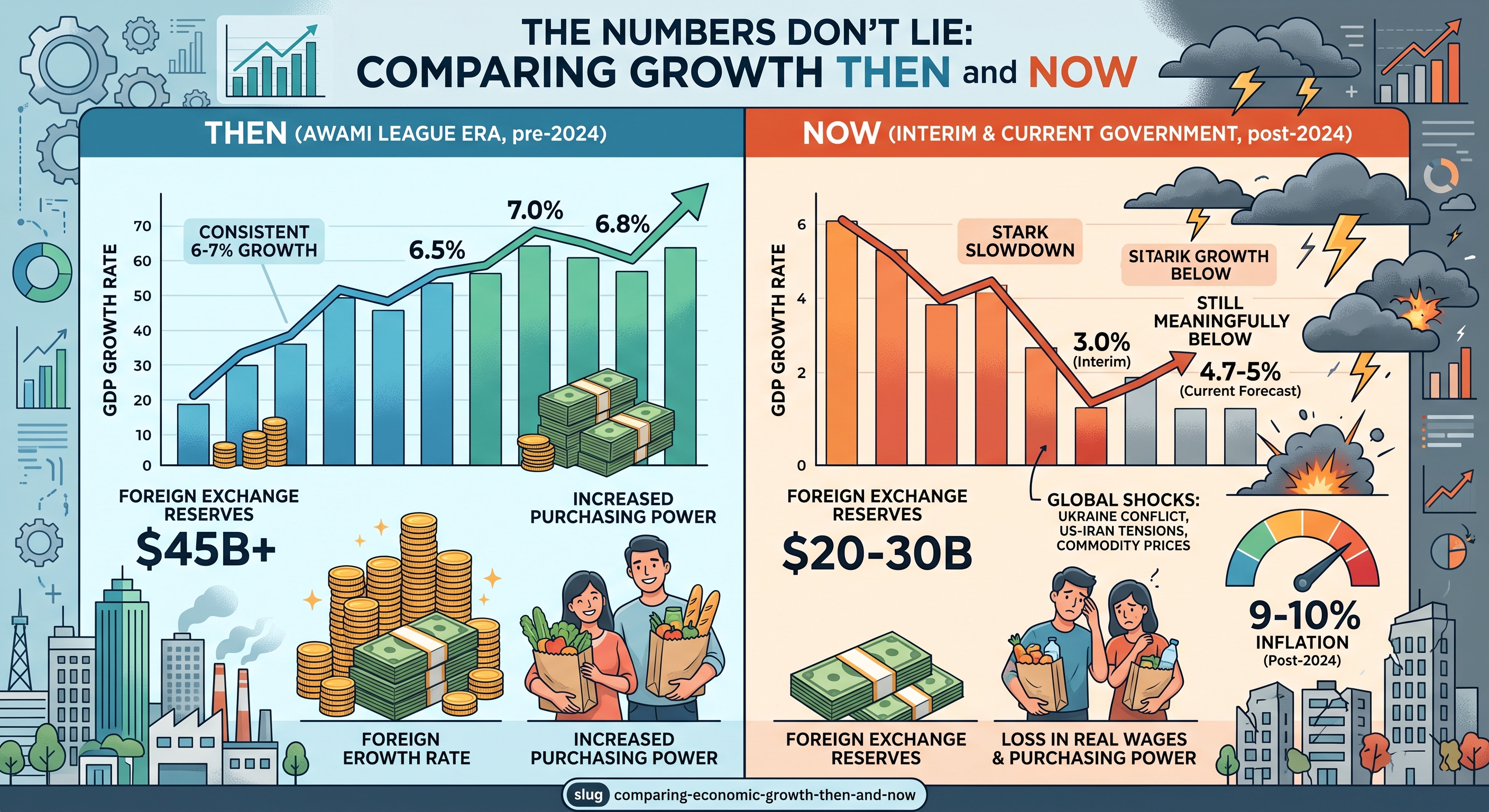
Under the last Awami League government, GDP growth ran between 6 and 7 percent for years, a run that outpaced most regional peers. Under the interim government that followed, growth collapsed to around 3 percent, and current forecasts for the BNP government's first full year in office put it back up to somewhere between 4.7 and 5 percent, still meaningfully below where the country was tracking before 2024. Foreign exchange reserves that once stood above $45 billion have fallen to somewhere between $20 and $30 billion. Inflation has stayed stuck near 9 to 10 percent for two straight years now, and real wages have consistently grown slower than prices, which means an actual, measurable loss in purchasing power for working households.
I want to be fair about the context. Some of this traces back to global shocks that hit during the last years of Awami League's own tenure too, the war in Ukraine, and now renewed fallout from the US-Iran conflict that flared up this year. No government fully controls global commodity prices or currency pressure. I'm not claiming otherwise.
But I also don't think "global headwinds" fully explains a fall from consistent 6-7 percent growth to a prolonged stretch closer to 3-5 percent, alongside reserves cut nearly in half. Continuity and stability were part of what that growth record depended on, and I think the last two years are a fairly direct demonstration of what happens when that continuity gets interrupted.
Post
The Numbers Don't Lie: Comparing Growth Then and Now
Log in or create an account to leave a comment.
No comments yet. Be the first to say something!